
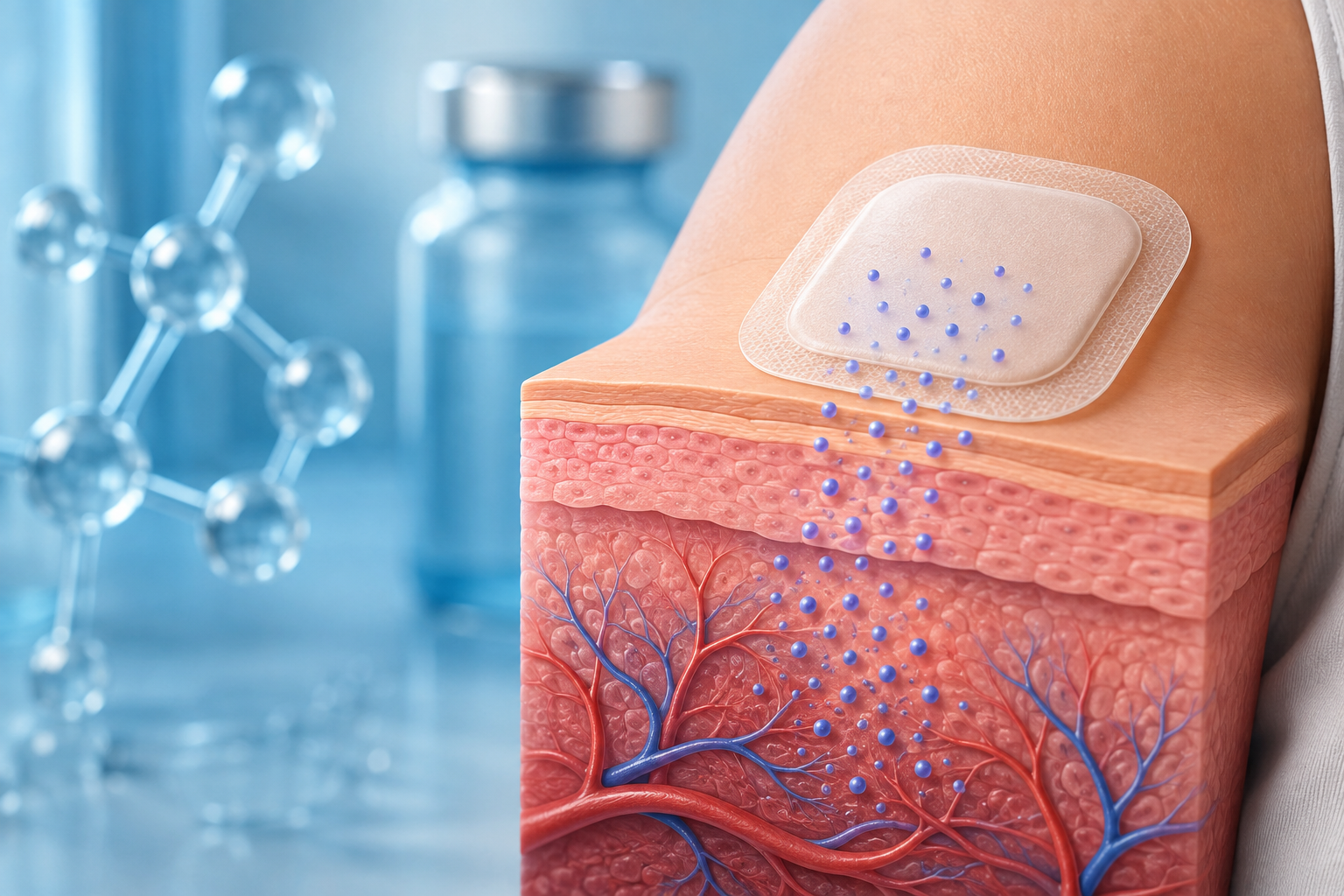
How Transdermal Drug Delivery Works
What Is Transdermal Drug Delivery?
Transdermal drug delivery is a method of administering medication through the skin so that the active ingredient can reach the systemic circulation or, in some applications, act within tissues beneath the skin.
A transdermal system may take the form of a patch or another specialized formulation designed to keep a medication in contact with the skin and facilitate its movement across the skin barrier.
The concept sounds simple, but the process is scientifically complex. The skin is specifically designed to protect the body from external substances, making it a significant barrier to pharmaceutical compounds. The outermost layer, called the stratum corneum, plays a particularly important role in limiting molecular transport across the skin.
This means that a drug cannot simply be placed on the skin and expected to enter the bloodstream. The medication, formulation, delivery system, and skin characteristics must work together to achieve appropriate absorption.
How Does a Transdermal System Work?
The basic process involves several stages.
First, the medication is incorporated into a delivery system. Depending on the product, the drug may be contained within a reservoir, polymer matrix, adhesive layer, gel, or another specialized formulation.
Once the system is applied to the skin, the active pharmaceutical ingredient begins moving from the formulation toward the skin surface. The drug then interacts with the outer skin barrier.
From there, molecules may move through the stratum corneum and into deeper layers of the skin. After passing through these barriers, the drug can reach blood vessels in the underlying tissue and enter systemic circulation when the product is designed for systemic delivery.
This movement is influenced by factors such as the drug’s molecular characteristics, concentration gradient, formulation, skin permeability, application site, and the design of the delivery system.
The objective is not simply to make a drug penetrate the skin. The objective is to control how much medication reaches the intended destination and how quickly it gets there.
The Skin Barrier and Why It Matters
The skin is one of the body’s most important protective barriers. While this is beneficial for preventing unwanted substances from entering the body, it presents a major challenge for pharmaceutical scientists developing transdermal drug delivery systems.
The stratum corneum consists of tightly packed cells and lipid structures that restrict the movement of many molecules. Its barrier properties are one of the primary reasons why only certain medications are suitable for conventional transdermal delivery.
For a drug to be a good candidate, researchers may consider characteristics such as molecular size, solubility, permeability, potency, and stability.
Because relatively small amounts of drug can often be delivered through the skin, highly potent medications may be particularly suitable for transdermal approaches when other formulation and safety requirements are met.
The Role of Controlled Release
One of the defining characteristics of many transdermal systems is controlled drug release.
Instead of receiving medication as a single dose, a properly designed system can release the active ingredient gradually over a predetermined period. This can help maintain drug exposure within a desired therapeutic range.
The phrase “Steady dosing without pills or injections.” captures one of the major concepts behind this approach.
Controlled release can also make administration more convenient. Depending on the medication and product design, a patient may not need to remember multiple doses throughout the day.
However, the actual dosing schedule varies from one product to another. Transdermal systems must be carefully engineered and clinically evaluated to determine the appropriate release profile.
Different Types of Transdermal Delivery Technologies
Traditional patches are only one part of the broader transdermal delivery field.
Passive Transdermal Delivery
Passive systems rely primarily on the natural movement of drug molecules through the skin.
A concentration gradient encourages the active ingredient to move from the formulation into and across the skin. Conventional patches commonly use this approach.
The formulation must be carefully developed because the skin naturally limits drug penetration. Researchers may therefore modify the formulation to improve solubility, stability, skin contact, and drug permeability.
Chemical Permeation Enhancement
Some formulations use chemical penetration enhancers to temporarily improve the movement of a drug through the skin.
These substances can alter interactions within the skin barrier and help certain pharmaceutical compounds penetrate more effectively. However, researchers must balance improved permeability with skin tolerability and safety.
Research continues to investigate different chemical and formulation approaches for overcoming the skin’s barrier properties.
Microneedle Systems
Microneedles represent another approach to transdermal drug delivery.
Instead of relying entirely on passive diffusion through the outermost skin layer, microneedles can create microscopic pathways through the skin barrier. These structures can be engineered to deliver pharmaceutical compounds while minimizing the discomfort associated with conventional injections.
Microneedle technology is an active area of research and is being investigated for a variety of drug and biological applications.
Physical Enhancement Technologies
Researchers have also investigated techniques such as iontophoresis, sonophoresis, electroporation, and other physical methods to improve drug transport through the skin.
These technologies attempt to temporarily alter the conditions affecting drug movement, potentially expanding the types of molecules that can be delivered through the skin.
What Happens After the Drug Crosses the Skin?
Once the active ingredient passes through the skin barrier, its next destination depends on the intended application.
For systemic transdermal drug delivery, the drug moves into the circulation and is transported throughout the body. This approach can be useful when the therapeutic effect is intended at a site away from the application area.
The transdermal route can also avoid some of the processes associated with oral administration. For example, certain transdermal systems can avoid gastrointestinal exposure and first-pass hepatic metabolism, depending on the drug and formulation.
For other formulations, the goal may be more localized action within or beneath the skin rather than systemic exposure.
Why Pharmaceutical Developers Use Transdermal Delivery
There are several reasons pharmaceutical researchers continue to investigate transdermal drug delivery.
Convenience is one important consideration. A patch or other delivery system may provide an alternative to frequent oral dosing or injections.
Controlled release is another advantage. A carefully engineered system can be designed to provide medication over an extended period rather than delivering the entire dose at once.
Patient adherence may also benefit from simpler administration. If a medication can be delivered through a longer-lasting system, patients may have fewer individual dosing events to remember.
Transdermal systems may also provide an alternative route for medications that have limitations when administered orally.
Research reviews have identified convenience, controlled release, prolonged therapeutic effects, and potential improvements in patient compliance among the important advantages associated with transdermal systems.
Challenges of Transdermal Drug Delivery
Despite its potential, transdermal drug delivery is not appropriate for every medication.
The skin barrier remains the central challenge. Many pharmaceutical molecules cannot naturally cross the skin at a sufficient rate to produce the desired therapeutic effect.
Drug properties can also create limitations. Molecular size, solubility, permeability, potency, and chemical stability all influence whether a medication is suitable for transdermal administration.
Skin condition and individual differences can also affect absorption. Variations in skin barrier function, hydration, thickness, age, and application location may influence drug transport.
Formulation scientists therefore need to evaluate both the drug and the delivery system during development.
Safety is another critical consideration. A product must deliver the intended amount of medication while minimizing irritation, unintended exposure, dose dumping, and other potential risks.
The Importance of Pharmaceutical Development
Developing a reliable transdermal product requires much more than placing an active ingredient inside an adhesive patch.
Scientists must evaluate the interaction between the drug, excipients, adhesive materials, backing layers, release mechanisms, packaging, and skin.
Manufacturing processes also need to provide consistent drug loading and predictable performance. Testing may examine factors such as drug release, adhesion, stability, skin permeation, and product quality.
Companies such as R & D Medical Products can play an important role in the development of advanced drug delivery solutions by supporting formulation, product development, and manufacturing considerations.
For developers, a successful product must combine scientific performance with practical usability. A delivery system that works well in laboratory testing but cannot maintain consistent performance during normal use may not provide the desired real-world benefits.
The Future of Transdermal Drug Delivery
The field continues to evolve as researchers look for ways to overcome the limitations of conventional patches.
New approaches involving microneedles, nanocarriers, advanced formulations, physical enhancement technologies, and combination systems are being studied. Recent reviews describe these technologies as part of ongoing efforts to improve drug permeability and expand the range of therapeutic compounds that may be delivered through the skin.
Future systems may also become more personalized and sophisticated. Researchers are investigating ways to better control drug release, improve skin penetration, reduce irritation, and create delivery platforms tailored to specific therapeutic needs.
As pharmaceutical technology advances, transdermal drug delivery may continue to provide valuable alternatives to conventional administration routes.
Final Thoughts
Understanding transdermal drug delivery requires looking beyond the familiar medication patch. The process involves pharmaceutical formulation, skin biology, controlled release, molecular transport, manufacturing, and careful safety evaluation.
The fundamental goal is straightforward: deliver an appropriate amount of medication through the skin at a controlled and predictable rate.
However, achieving that goal requires sophisticated science because the skin is naturally designed to prevent substances from entering the body. Advances in formulation science, penetration enhancement, microneedles, and other technologies are helping researchers explore new possibilities.
For pharmaceutical companies and product developers, understanding these principles can support the development of innovative delivery systems that offer convenient and controlled alternatives to traditional pills and injections.
Frequently Asked Questions
What is transdermal drug delivery?
Transdermal drug delivery is a method of administering medication through the skin. In systemic applications, the active pharmaceutical ingredient crosses the skin barrier and enters the bloodstream.
How does a transdermal patch deliver medication?
A transdermal patch contains medication within a specially designed delivery system. The drug is released toward the skin and then moves across the skin barrier at a controlled rate.
Does transdermal drug delivery enter the bloodstream?
Some transdermal systems are specifically designed for systemic delivery. In these systems, the medication passes through the skin and enters the circulation. Other topical or dermal products are designed primarily for localized effects.
Why can’t every drug be delivered through the skin?
The skin is an effective protective barrier, and many drug molecules cannot penetrate it efficiently enough to reach therapeutic concentrations. Drug size, molecular properties, potency, solubility, and formulation all influence suitability for transdermal administration.
What are the advantages of transdermal drug delivery?
Potential advantages include controlled release, convenient administration, prolonged drug exposure, and avoiding some gastrointestinal processes associated with oral medication.
What technologies can improve transdermal delivery?
Researchers have investigated chemical penetration enhancers, microneedles, iontophoresis, sonophoresis, electroporation, nanocarriers, and other technologies to improve drug transport across the skin.
Is transdermal delivery the same as topical medication?
Not necessarily. Topical medications are generally intended to act primarily at or near the application site, while transdermal systems are designed to move medication across the skin and, in many cases, into systemic circulation.