
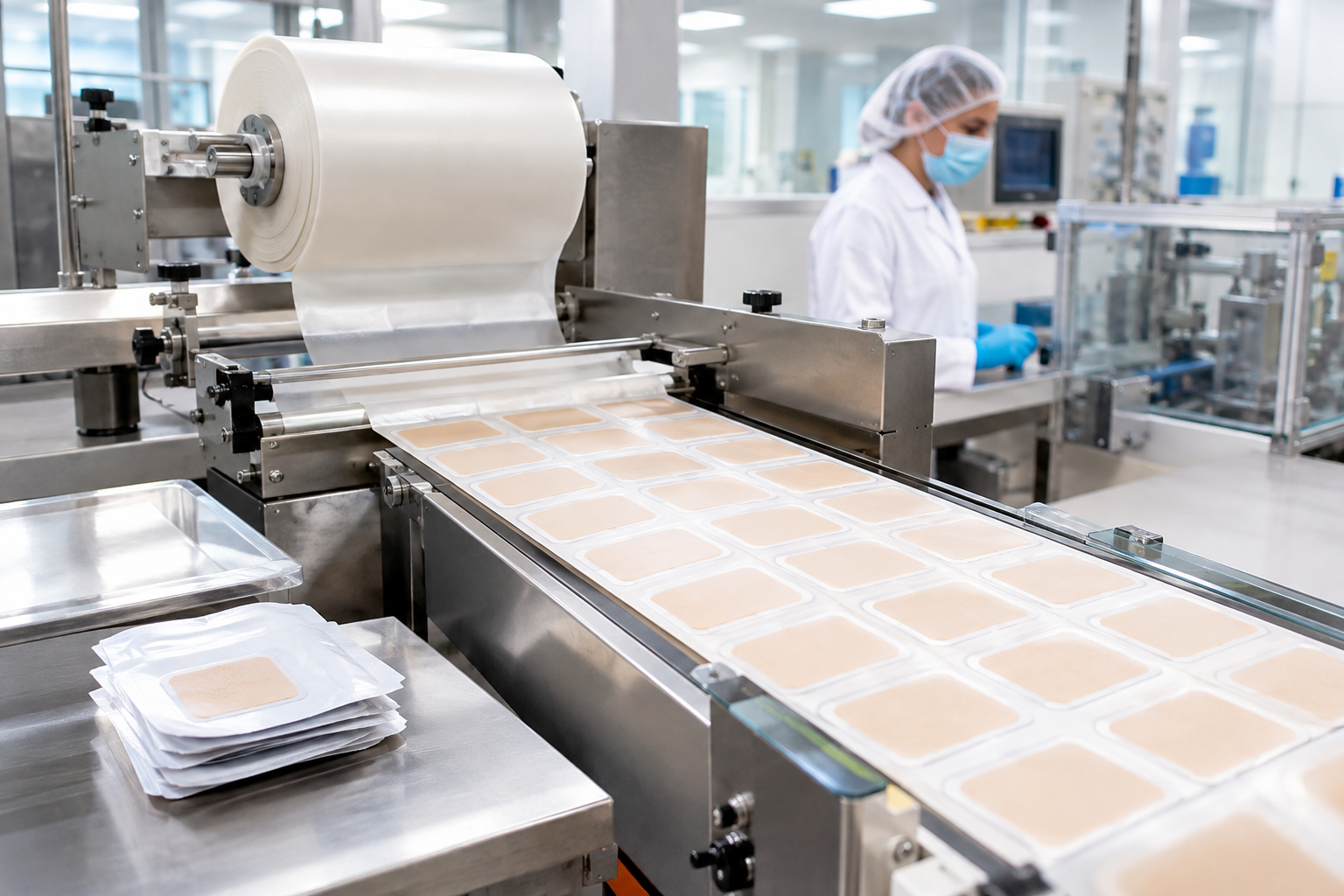
Pain Patch Manufacturing: From Formulation to Finished Pouch
Understanding Pain Patch Formulation
Formulation is the foundation of pain patch manufacturing. Before production equipment is selected or a manufacturing line is configured, developers must determine how the active ingredient will be incorporated into the patch and delivered through the intended application method.
A typical formulation may contain an active pharmaceutical ingredient, an adhesive or polymer matrix, solvents or processing aids where appropriate, stabilizers, and other excipients. The exact ingredients depend on the product design, intended use, regulatory requirements, and desired release characteristics.
Some patches incorporate the active ingredient directly into an adhesive matrix. Others use a separate drug reservoir or layered structure designed to control how the ingredient is released. Each approach presents different manufacturing requirements.
Selecting the Right Materials
Material compatibility is one of the first considerations. The active ingredient must remain sufficiently stable throughout manufacturing and storage, while the adhesive, backing, and release liner must perform their intended functions.
Formulation teams evaluate several factors, including:
- Ingredient compatibility: Whether the active ingredient interacts with other formulation components.
- Adhesion: Whether the patch maintains appropriate contact with the skin during intended use.
- Flexibility: Whether the patch bends without cracking, separating, or losing its structural integrity.
- Release characteristics: Whether the product meets its established drug release specifications.
- Stability: Whether the formulation maintains acceptable properties throughout its intended shelf life.
- Skin compatibility: Whether the finished product meets applicable safety and tolerability requirements.
These properties must be evaluated together. Improving one characteristic does not automatically improve the entire product. For example, changing an adhesive may affect tack, flexibility, ingredient migration, and drug release simultaneously.
Establishing a Repeatable Formulation
Once candidate materials have been selected, development teams establish controlled mixing procedures and formulation parameters. These may include ingredient addition order, mixing speed, temperature, mixing duration, and viscosity limits.
The objective is to create a uniform formulation that can be reproduced consistently at larger production volumes.
Laboratory results alone are not sufficient to guarantee successful commercial manufacturing. A formulation that performs well in a small batch may behave differently when processed in a large mixing vessel or applied across a wider coating surface.
For this reason, development and process engineering teams work together to identify critical process parameters and define suitable operating ranges before scaling up production.
How a Pain Patch Moves Through the Production Line
How a pain patch moves from formulation through coating, die cutting, and pouching, and where quality issues typically appear in the production line.
This process follows a series of connected manufacturing stages. Although specific equipment and procedures vary by product, the general workflow begins with formulation preparation and continues through coating, drying or curing when required, lamination, converting, inspection, and final packaging.
Step 1: Mixing and Formulation Preparation
Manufacturing begins with the controlled preparation of the formulation. Ingredients are weighed according to approved instructions, and mixing equipment is used to achieve the required level of uniformity.
Depending on the formulation, the process may involve dissolving ingredients, dispersing solids, preparing an adhesive mixture, or incorporating an active ingredient into a polymer matrix.
Common quality concerns at this stage include inaccurate weighing, incomplete mixing, contamination, excessive air incorporation, and unexpected changes in viscosity. Each issue can affect downstream processing.
For example, a formulation with inconsistent viscosity may spread unevenly during coating. Inadequate mixing may also contribute to variations in active ingredient concentration across the finished patch.
Manufacturers typically use approved batch records, calibrated weighing equipment, defined mixing parameters, and in-process sampling to help maintain consistency.
Step 2: Coating the Formulation
Coating transfers the prepared formulation onto a suitable backing, release liner, or other designated substrate. Depending on the product design, manufacturers may use slot-die coating, knife-over-roll coating, or another validated coating method.
The goal is to produce a consistent layer across the intended web width and length. Coating weight, thickness, formulation distribution, and surface appearance are important process characteristics.
Several issues can emerge during coating:
- Uneven coating thickness across the web.
- Streaks, bubbles, pinholes, or surface defects.
- Variations in coating weight.
- Poor wetting or adhesion to the substrate.
- Edge buildup or inconsistent coating boundaries.
These defects may originate in the formulation, equipment setup, substrate condition, or environmental conditions.
Manufacturers can reduce these risks through suitable equipment configuration, controlled web tension, validated operating parameters, and regular in-process inspections. Monitoring coating weight and thickness helps identify variation before large quantities of material are processed.
Step 3: Drying, Curing, or Conditioning
Some formulations require drying to remove processing solvents or conditioning to achieve the required physical properties. Other designs may use different setting or curing mechanisms.
The process must be appropriate for the formulation and the materials being processed. Excessive heat or unsuitable drying conditions can affect ingredient stability, adhesive behavior, or the final structure of the patch.
Insufficient drying may leave unacceptable residual solvent levels where solvent removal is required. Uneven drying can also cause differences in coating properties across the production web.
Manufacturers establish and validate the necessary temperature, airflow, residence time, and other relevant parameters. Residual solvent testing may be required when applicable to the product and manufacturing process.
At this stage, quality teams also consider whether the material has achieved the physical characteristics needed for subsequent lamination and converting operations.
Step 4: Lamination and Layer Assembly
Many pain patches contain multiple layers, such as a backing film, an active formulation layer, an adhesive layer, and a removable release liner. The arrangement depends on the intended product architecture.
Lamination joins designated layers while maintaining the required structural integrity. Pressure, alignment, material compatibility, and web tension can influence the result.
Potential defects include wrinkles, trapped air, incomplete bonding, misalignment, and separation between layers. These problems may interfere with handling, cutting, packaging, or product performance.
Careful material qualification and controlled lamination conditions help prevent these issues. Inspection is particularly important when the patch contains several functional layers that must remain correctly positioned throughout use.
Step 5: Precision Die Cutting
After the coated material has reached the required condition, it is converted into individual patches. Die cutting creates the specified dimensions and shapes while helping preserve clean edges and consistent product geometry.
Rotary and flatbed die-cutting systems may be used depending on production volume, material characteristics, and design requirements.
Typical quality concerns include irregular edges, dimensional variation, incomplete cuts, damaged liners, and unwanted adhesive buildup on cutting tools. Cutting defects can affect product presentation and may make patches more difficult to remove from their liners.
Accurate registration is also important when printed markings, multiple layers, or specific orientation requirements are involved.
Manufacturers use defined cutting tolerances, routine tool inspections, and dimensional checks to maintain consistency. Rejects should be identified and handled according to approved procedures so defective units do not enter the packaging stage.
Step 6: Inspection and In-Process Quality Control
Inspection connects the individual manufacturing stages. Rather than waiting until the end of production, manufacturers evaluate important quality attributes at appropriate points throughout the process.
Depending on the product, checks may include visual appearance, patch dimensions, coating uniformity, adhesive properties, layer alignment, active ingredient content, and other specified characteristics.
Automated inspection systems can help identify visible defects at production speed, while laboratory testing provides information about characteristics that cannot be assessed through appearance alone.
The sampling plan and acceptance criteria should be established according to the product’s quality requirements and applicable regulations. Testing should not be treated as a substitute for a controlled manufacturing process.
Step 7: Pouching and Final Packaging
The final production stage protects individual patches from environmental exposure and supports product identification, storage, and distribution.
Patches are placed into suitable pouches, which may incorporate barrier materials selected to protect against moisture, oxygen, light, or other relevant environmental factors. The required protection depends on the formulation and the product’s demonstrated stability needs.
Packaging equipment must position each patch correctly and produce seals that meet established specifications. Poorly formed seals, contamination in the seal area, damaged packaging film, or incorrect pouch dimensions can compromise package integrity.
Common checks include seal inspection, verification of packaging materials, print and label verification, code readability, and other required packaging controls. Seal integrity testing and package leak testing may be appropriate depending on the packaging design.
Manufacturers also verify that lot numbers, expiration dates, product information, and other required labeling details are correct before release.
Where Quality Issues Typically Appear
Quality problems often become more expensive when they are detected late. A coating defect identified during production may be corrected before the entire batch is processed, while the same defect discovered after pouching may require extensive investigation and rejection of packaged units.
The following table summarizes common problems and the manufacturing stages where they may originate.
| Production stage | Potential quality issue | Prevention or control |
|---|---|---|
| Formulation | Ingredient variation or poor mixing | Controlled weighing, mixing procedures, and batch sampling |
| Coating | Uneven thickness or surface defects | Process monitoring and coating inspections |
| Drying or conditioning | Inadequate solvent removal or altered material properties | Validated operating conditions and appropriate testing |
| Lamination | Wrinkles, trapped air, or layer separation | Material qualification and alignment controls |
| Die cutting | Incorrect dimensions or damaged edges | Tool maintenance and dimensional inspection |
| Pouching | Weak seals or damaged packaging | Seal monitoring and package integrity checks |
| Final release | Incorrect records or unresolved deviations | Batch record review and documented quality approval |
Investigations should focus on identifying the underlying cause rather than simply correcting the visible defect. For example, repeated coating streaks may be related to formulation viscosity, substrate cleanliness, or equipment conditions. Corrective action is more effective when it addresses the source of variation.
The Importance of Quality Assurance and Documentation
Quality assurance supports every stage of pain patch manufacturing. It establishes the procedures, records, controls, and review processes needed to demonstrate that production has been performed consistently and that the finished product meets its specifications.
For products regulated as drugs or drug-device combinations, applicable requirements depend on the product classification and the markets where the product will be sold. Manufacturers must determine which regulatory standards, quality system requirements, and testing obligations apply to their specific products.
Documentation generally includes approved manufacturing instructions, raw material records, equipment maintenance and calibration records, in-process results, deviations, corrective actions, packaging records, and final release documentation.
Change control is equally important. A change to the adhesive, backing film, active ingredient supplier, coating equipment, or pouch material can influence product performance. Changes should be evaluated and approved through the applicable quality system, with additional testing or validation when required.
A documented quality system also helps manufacturers investigate complaints, identify recurring issues, and implement improvements based on production data.
Scaling From Development to Commercial Production
Moving a pain patch from laboratory development to commercial production requires more than increasing batch size. Manufacturing teams must confirm that the formulation and process remain suitable when equipment dimensions, processing speeds, and material volumes change.
Scale-up activities may include pilot production, equipment qualification, process validation, stability studies, and assessments of critical quality attributes.
For example, a formulation may mix uniformly in a small vessel but develop temperature or viscosity differences in a larger tank. Similarly, coating performance can change when the production web runs at higher speeds or across a wider surface.
A structured scale-up plan helps identify these differences before routine commercial manufacturing begins. It also gives engineering, formulation, quality, and packaging teams a shared understanding of the parameters that must remain controlled.
Companies evaluating manufacturing partners may consider their technical experience, quality systems, equipment capabilities, documentation practices, and ability to support development through commercial production. Organizations such as R & D Medical Products may be relevant when researching medical product development and manufacturing capabilities, but any specific services or qualifications should be verified directly before selecting a partner.
Improving Efficiency Without Compromising Product Quality
Manufacturers can improve production efficiency by identifying the sources of recurring defects and reducing unnecessary variation. Useful approaches include preventive equipment maintenance, operator training, standardized setup procedures, in-process monitoring, and trend analysis.
Production data can reveal whether defects occur more frequently with particular material lots, equipment settings, shifts, or packaging configurations. Investigating these patterns can help teams prioritize improvements and reduce avoidable waste.
Automation may improve inspection consistency and reduce repetitive handling, although automated systems must be appropriately qualified and maintained. Likewise, faster production speeds are beneficial only when the process continues to meet established quality requirements.
The most effective manufacturing strategy balances throughput, material utilization, worker safety, regulatory compliance, and finished-product quality. Improvements should be supported by data and evaluated to ensure they do not introduce new risks.
Conclusion
Pain patch manufacturing is a coordinated process that begins with formulation development and continues through coating, drying or conditioning, lamination, die cutting, inspection, and final pouching. Each stage presents distinct challenges, and a problem in one operation can affect the quality of the finished product.
Consistent results depend on selecting compatible materials, establishing repeatable processing conditions, monitoring critical quality attributes, maintaining accurate documentation, and investigating defects at their source. Careful scale-up and validated controls help ensure that the manufacturing process remains reliable as production volumes increase.
By understanding how each stage contributes to the finished patch, manufacturers can make better process decisions, improve production efficiency, and build a stronger foundation for consistent product quality.
Frequently Asked Questions
1. What are the main stages of pain patch manufacturing?
The main stages typically include formulation preparation, coating, drying or conditioning when required, lamination, die cutting, in-process inspection, pouching, labeling, and final quality review. The exact sequence depends on the patch design and manufacturing technology.
2. Why is formulation consistency important?
Formulation consistency helps ensure that the active ingredient and other components are distributed appropriately throughout the product. Variations can affect coating performance, adhesive properties, product stability, and compliance with established specifications.
3. What causes coating defects in pain patches?
Coating defects may result from inconsistent viscosity, unsuitable equipment settings, contamination, substrate problems, trapped air, or variations in coating speed and thickness. Identifying the root cause helps prevent recurring defects.
4. Why is die cutting important?
Die cutting determines the patch’s final dimensions and shape. Accurate cutting helps maintain product consistency, supports reliable handling, and reduces defects such as ragged edges, incomplete cuts, and damaged release liners.
5. What quality checks are important during pouching?
Important checks may include pouch positioning, seal appearance, seal integrity, packaging material verification, label accuracy, lot identification, and expiration date verification. The specific controls depend on the packaging design and applicable product requirements.
6. How can manufacturers reduce waste during production?
Manufacturers can reduce waste by monitoring critical process parameters, maintaining equipment, inspecting materials during production, training operators, analyzing defect trends, and correcting root causes before problems spread across an entire batch.
7. Why is packaging material selection important for pain patches?
Packaging helps protect the product from environmental conditions that could affect its stability. Suitable materials and reliable seals support product integrity during storage, transportation, and distribution. Packaging suitability should be supported by appropriate testing and stability evidence.
Schema Markup
The following JSON-LD provides structured data for the article and its frequently asked questions. Review the page URL and publication details before publishing, and ensure that the FAQ content matches the visible article. FAQ structured data does not guarantee enhanced search results.