
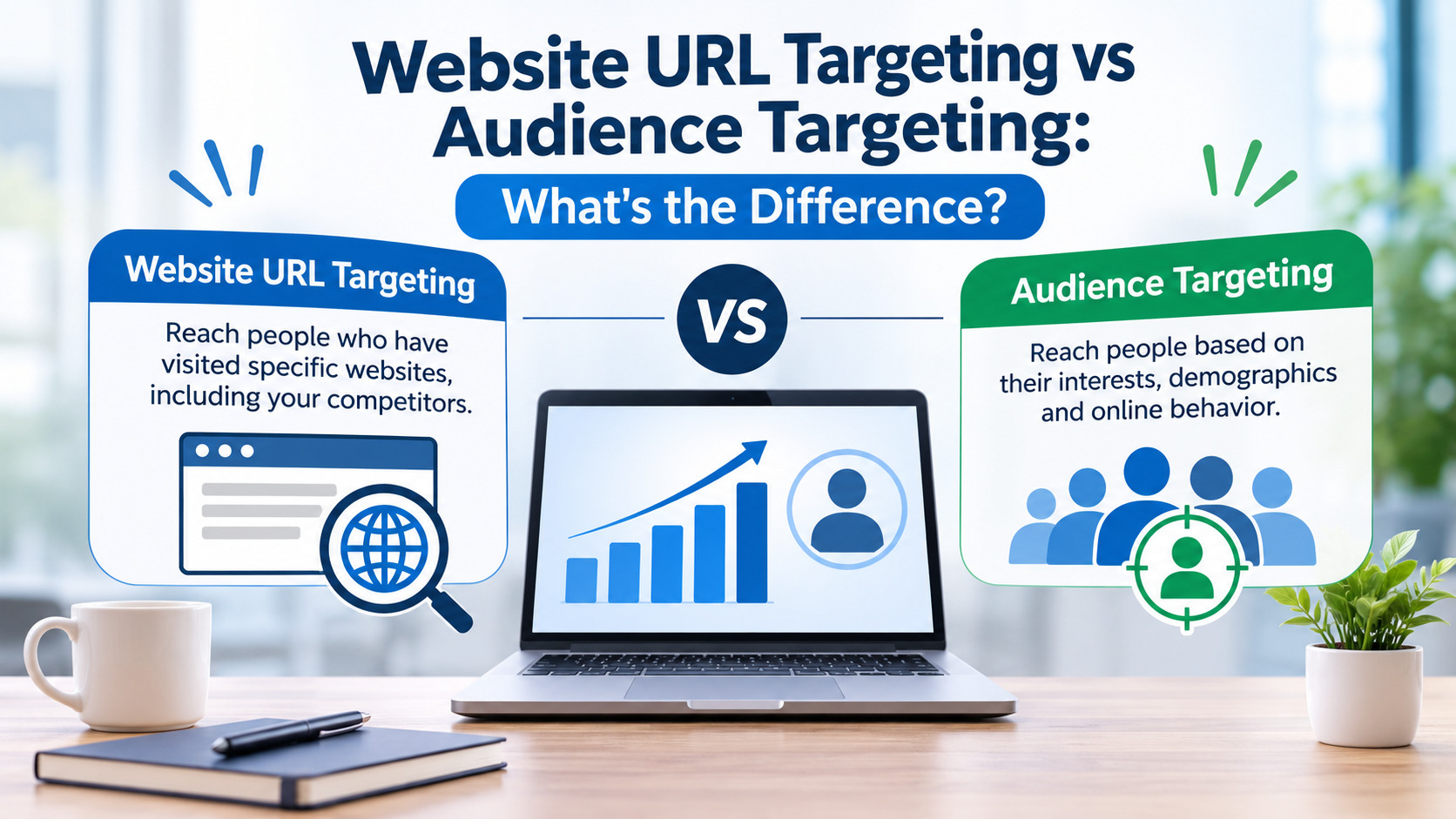
Website URL Targeting vs Audience Targeting: What’s the Difference?
Reaching the right people is one of the biggest challenges in digital marketing. Businesses invest in advertising, website optimization, and lead generation, but not every visitor has an interest in their products or services. This is where website URL targeting and audience targeting can make a difference. Both approaches help businesses connect with potential customers, but they work in different ways. While audience targeting focuses on identifying people based on their interests, demographics, and online behavior, URL targeting can help businesses reach people who have already visited specific websites, including those of their competitors. Understanding the difference can help marketers make better advertising decisions and get more value from their marketing budgets.
What Is Website URL Targeting?
Website URL targeting is a digital advertising strategy that allows businesses to reach potential customers based on the websites they have previously visited. Instead of relying only on general audience categories, this approach focuses on people’s interest in particular businesses, products, or services.
For example, imagine you own a company that provides property management services. Several competing companies in your area have websites where potential customers research rental management, property maintenance, and related services.
With website URL targeting, you can reach people who have visited those competing websites and introduce your business through relevant advertisements.
The main advantage is that you are not starting with a completely unfamiliar audience. These visitors have already shown some interest in the industry, which can make them valuable prospects.
Businesses can use this approach through display advertising, social media advertising, and remarketing campaigns to send potential customers to their websites.
How it works:
- Identify competitor websites that attract your ideal customers.
- Use a URL targeting solution to build an audience based on visits to those websites.
- Develop relevant advertising messages for that audience.
- Reach eligible prospects through supported advertising channels.
- Monitor campaign performance and optimize based on engagement and conversions.
This approach is particularly useful for businesses operating in competitive industries where customers often compare multiple providers before making a purchase.
What Is Audience Targeting?
Audience targeting is a digital marketing method that helps advertisers reach people based on specific characteristics, interests, and behaviors. Rather than focusing on which websites people have visited, traditional audience targeting uses information such as:
- Age and gender
- Geographic location
- Interests and hobbies
- Online shopping behavior
- Professional roles and industries
- Previous interactions with a brand
- Device usage and browsing behavior
For example, a company selling fitness equipment may target people interested in exercise, gym memberships, weight training, and healthy lifestyles.
Similarly, a B2B software company may create advertising campaigns targeting business owners, marketing managers, or IT professionals. Audience targeting helps advertisers narrow their reach and show relevant messages to specific groups of people.
However, a person belonging to a particular audience category does not necessarily mean they are actively considering your product or service. Someone interested in fitness may not be planning to purchase gym equipment anytime soon. This is one reason businesses are increasingly interested in more specific targeting strategies.
Website URL Targeting vs Audience Targeting: Key Differences
Both strategies help businesses reach potential customers, but their targeting methods and applications are different.
Here are the main differences:
| Comparison | Website URL Targeting | Audience Targeting |
| Targeting method | Based on visits to selected websites | Based on audience characteristics and behavior |
| Main focus | Website browsing activity | Interests, demographics, and user attributes |
| Audience intent | Can indicate interest in a specific business or industry | Varies depending on the selected audience |
| Competitor research | Can target visitors of competitor websites | Usually relies on broader audience segments |
| Personalization | Ads can be tailored to competitor-related interests | Ads are tailored to audience profiles |
| Best application | Competitor customer acquisition | Reaching defined customer groups |
| Marketing objective | Attract potential customers from competing websites | Reach relevant people across advertising channels |
The biggest difference comes down to how you identify potential customers. Audience targeting helps you reach people who match a particular profile. Website URL targeting helps you reach people based on their visits to selected websites.
For businesses looking to acquire customers from competitors, the second approach offers another way to build advertising audiences.
How Does Website URL Targeting Help Businesses Reach Competitor Visitors?
One of the most interesting applications of URL targeting is competitor customer acquisition. When people visit a competitor’s website, they may be researching products, comparing prices, checking services, or looking for a solution to a particular problem. These visitors could represent potential customers for other businesses offering similar products or services.
Competitor Online Targeting gives businesses an opportunity to reach this audience instead of relying entirely on conventional advertising segments. Consider a practical example. A local roofing company wants to attract more residential customers. Instead of targeting everyone interested in home improvement, it can identify relevant competitor websites and use URL targeting technology to reach eligible visitors from those websites. The company can then run advertisements highlighting its roofing services, customer reviews, warranties, or free inspection offers.
This strategy can be useful for:
- Local service providers competing for customers in the same area.
- E-commerce businesses selling similar products.
- SaaS companies looking to attract customers from competing platforms.
- Professional service firms targeting businesses researching alternative providers.
- Healthcare and wellness businesses competing for service inquiries.
The idea is simple: connect with people who may already be exploring solutions in your industry and give them another option to consider.
The Role of Website Visitor Tracking in Better Marketing Decisions
Finding potential customers is only one part of a successful marketing strategy. Businesses also need to understand what happens after visitors arrive on their websites. This is where website visitor tracking becomes important. Website visitor tracking helps businesses understand how people interact with their websites. Depending on the tracking technology and available data, marketers can examine:
- Which pages receive the most visits.
- How visitors navigate through the website.
- Which products or services attract attention.
- Where visitors leave the website.
- Which marketing channels bring traffic.
- How visitors interact with important landing pages.
These insights help businesses identify areas that need improvement. For example, if a large number of visitors reach a service page but leave without submitting an inquiry, the business may need to improve its page content, calls to action, pricing information, or contact process.
With real time website visitor tracking, businesses can also gain a more immediate view of website activity, depending on the capabilities of their tracking solution.
It is important to understand that analytics tracking and individual visitor identification are not always the same thing. Standard analytics may report aggregated activity, while specialized visitor identification tools may provide additional business or contact information where technically available and legally permitted.
How Visitor Identification Helps Turn Website Traffic into Leads
Many businesses receive website traffic but struggle to understand who their visitors are or how to turn those visits into opportunities. This is where website visitor identification can provide additional marketing insights.
Specialized visitor identification technology can help businesses get website visitor information beyond basic pageview and traffic reports. Depending on the solution, available data, and applicable privacy requirements, this may include business or contact details associated with certain website visits.
For example, a company may use visitor tracking to understand which businesses are showing interest in its services. Its sales and marketing teams can then use available insights to plan relevant follow-ups and improve their lead generation activities.
Real time visitor tracking can also help marketers monitor website activity more closely and identify patterns in visitor engagement.
However, businesses should not assume that every anonymous visitor can be identified by name or that every visit will produce contact information. Results depend on the technology, data availability, device and network conditions, and applicable privacy and consent requirements.
The goal is to make better use of available website data rather than treating every website visit as a guaranteed sales lead.
Common Mistakes to Avoid When Using These Targeting Strategies
Even the right targeting method can produce disappointing results if campaigns are not planned properly.
Here are some common mistakes businesses should avoid:
1. Targeting too many competitor websites: Not every competitor attracts the same type of customer. Focus on websites that are relevant to your products, services, and ideal customer profile.
2. Using the same advertisement for everyone: A visitor researching pricing may need different information from someone exploring service features. Match your advertising message to the audience’s likely needs.
3. Ignoring landing page quality: Getting visitors to your website is not enough. Your landing pages should clearly explain your offering and make it easy for people to contact your business.
4. Depending only on audience targeting: Broad audience categories can bring traffic without necessarily bringing qualified leads. Consider additional targeting methods when your business needs more specific customer acquisition strategies.
5. Not measuring campaign results: Review conversion rates, cost per lead, engagement, and overall acquisition costs. Use this information to improve targeting and advertising messages.
Which Strategy Should Your Business Choose?
The right approach depends on your marketing objectives, industry, and customer acquisition goals. Audience targeting is a good choice when you want to reach people based on demographics, interests, locations, or professional characteristics. It works well for brand awareness, product promotion, and reaching specific customer segments.
Website URL targeting is worth considering when your goal is to reach people who have already visited relevant competitor websites. It can be particularly useful for businesses in competitive markets where customers regularly compare different providers.
You do not necessarily have to choose one over the other. Combining both strategies can help you reach relevant prospects while making your advertising more focused.
How AimLogic Helps Businesses Use Website URL Targeting
At AimLogic, we offer specialized marketing technology designed to help businesses reach potential customers and improve their customer acquisition strategies.
Our CompetitorLogic solution uses proprietary, patented targeting technology to connect businesses with people who have visited competitor websites. It supports several approaches, including Website URL Targeting, Search URL Targeting, GEO Targeting, Reverse Targeting, and Industry Targeting.
The goal is to help businesses reach relevant prospects through display advertising, social media, and retargeting opportunities. For businesses that want to understand their existing website traffic, VisitorLogic provides visitor tracking and insights into visitor behavior, interactions, and potential identification opportunities.
Our other solutions, including DataLogic and SEOLogic, support data-driven marketing and search optimization efforts. search optimization efforts. Rather than relying on a single advertising method, businesses can consider these solutions as part of a broader strategy focused on attracting relevant traffic, generating leads, and improving marketing performance.
Final Thoughts
Website URL targeting and audience targeting serve different purposes, but both can contribute to a stronger digital marketing strategy. Audience targeting helps businesses reach people based on their characteristics and interests, while website URL targeting creates opportunities to connect with people who have visited relevant competitor websites.
For businesses looking to improve customer acquisition, the important step is choosing a strategy that matches their goals. Combining competitor-focused targeting, visitor tracking, relevant advertising, and ongoing campaign optimization can help turn marketing activity into more meaningful business opportunities.
If you want to reach potential customers who are already exploring competing services, we can show you how Website URL Targeting and our other solutions fit your customer acquisition goals. Contact us to get started.

Related Posts

Wind Energy Solutions Transforming Our Future

Comparing Global Offshore Wind Farm Initiatives